
Holy Trinity’s newest structure, the IDEAS institute, is hard to miss when walking through campus – or even from Pineda causeway coming from the beachside. The institute’s large windows, engineering spaces, and modern design make it easily recognizable. The school’s blue and gold chairs in the high school building are known to many. But what isn’t as well known is the inspiration and psychology behind the school’s new and long-lasting design choices.
Jennifer Bergendal, who teaches Interior Design at Holy Trinity, explained the effects of having the large windows in the IDEAS building.* “In the IDEAS Center [sic], there are two things that happen with all those windows: when you’re sitting inside that classroom, you kind of feel like you’re a little bit in the fishbowl,” said Bergendal. “And so that’s a new feeling to get over because we’re not used to being in a space like that. But what’s really cool about that is you see a lot of those things that are going on in those classrooms, the labs, the photography and creatives, on the base floor.” Upon entering the foyer of the building, one can directly see the engineering room, where projects and equipment are normally on display. Further, the school’s broadcast room is visible and recognized by the large green wall and colorful writing on the floor-to-ceiling glass windows. This feature is reserved for the new building, and contrasts to the smaller windows placed on the doors of the older classrooms. Most students have classes with each type of window design. So, what is the difference? “Not having any windows and not having a sufficient amount of light, it may not impact the students as much, but it really impacts the teachers,” said Bergendal. Bergendal said that windows allow for a sense of reality outside of the classroom. “You know, [without windows], there could be a huge storm and you would have no idea because you’re completely turned off. There’s something about our psychology and wanting to be connected to nature and to be able to look outside.” Bergendal compares the inexpensive ‘standard’ windows to long, thin windows on the very top of the wall, which would allow for more wall space, and yet you would still have natural sunlight that would come in and connect you to the outdoors.
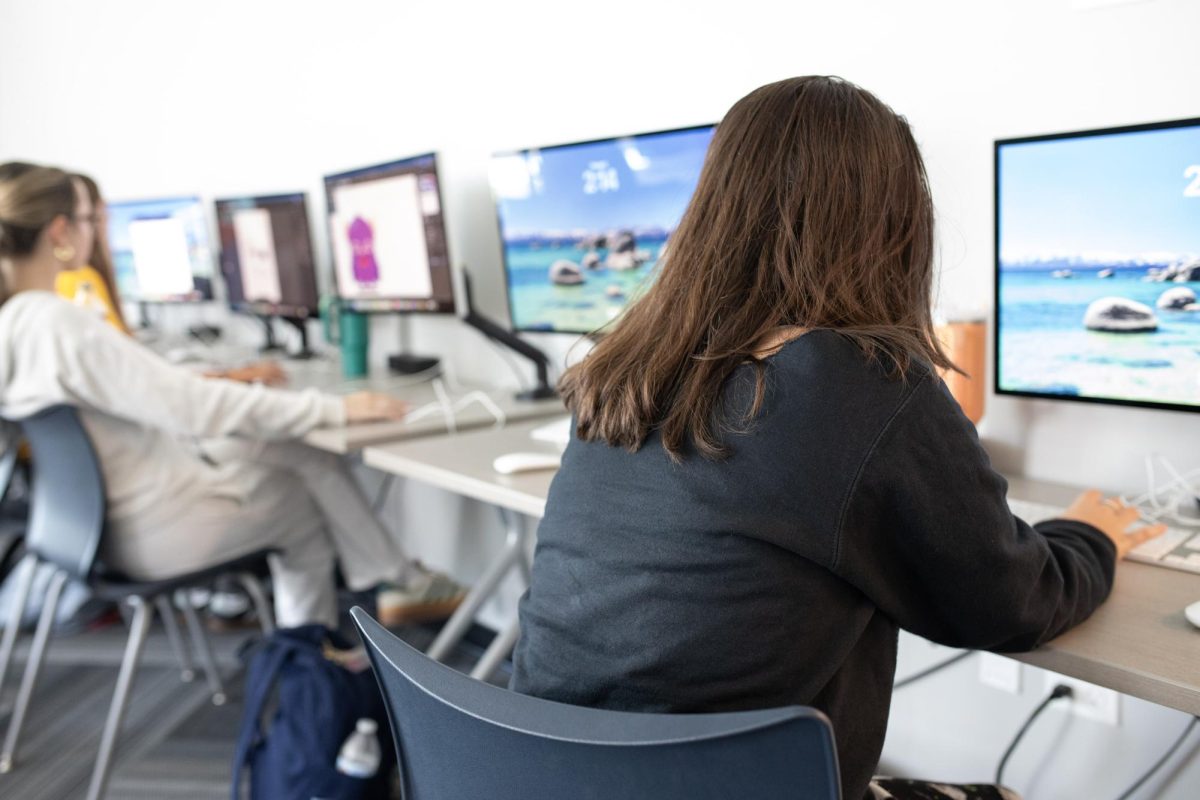
Bergendal also explained the ergonomics of classroom chairs – like how the height, angles, and amount of time you’re actually in the chair – can influence your learning through how comfortable and confident you feel. She noted that some modern office or school spaces have adapted to a more contemporary option of standing desks for a more natural posture. Bergendal said many people have different ways of promoting concentration in themselves, and in regards to Holy Trinity classrooms, a variety of seating options is a factor to be considered when creating effective learning spaces. Similarly, the accessibility of classroom spaces for less able-bodied students, teachers, and staff should be considered.
As mentioned previously, the blue, grey, white, and tan of the school’s classrooms become a second thought when these colors are seen daily. But these have a background inspiration too. Blue and tan, the campus’ most common color choices, have relaxing or calming effects that tend to promote an inviting, comfortable scene according to colorpsychology.org. “There is psychology behind certain colors,” Bergendal said. “White light can tend to make people more agitated, where softer lighting can make people feel a little more relaxed.” Although warmer lighting could be implemented in future classroom design, fluorescent lighting is a common option for office and school spaces around the world because of its affordability. As it decreases students’ visual distractions for the purpose of better sensory integration, natural sunlight is optimal for lighting. Bergendal suggests an up-to-date approach, “In designs, there are several things you need to do, especially when working with lighting. I personally really like the settings that are more like daylight, where it’s not necessarily warm light, because those can become a little too yellow. We use [fluorescent lighting] because it’s a really cheap way of powering lamps. But since we’ve had new technology with LED lights, we have a lot more options – they’re low energy, and they usually offer you a variety on the spectrum of light, from cool to warm.
The interior decoration is equally as important as structure and design when crafting the classroom atmosphere. Lisa Dykes, who teaches four AP courses at Holy Trinity, explained how she learned from past experiences that classroom lighting and decorations can make or break students’ ability to focus and pay attention in class. “All the lights I’ve chosen for my classroom have the ability to be muted,” said Dykes. “Years ago, I had more stuff in [my classroom]. This is actually the toned-down version. The majority of the visuals are my point of view, not student point of view, so I do take that into account when it comes to kids being distracted because it’s fun to look at for me, but maybe not so much for students.” Dykes recognizes the difference in point of view from student to teacher on learning spaces. Clearly, teachers are in one room for the majority of their work day, while students are frequently changing surroundings. “I treat my room really like it’s my home, and I feel like everything from decor, to lighting, to standing at the door to greet people to come in, to even the way the room smells is important,” said Dykes. Dykes considers attention to detail crucial when creating a comfortable learning environment for a student. “If you have an inviting location, students feel like it’s their space too, like it’s a combined space for us to learn together. When students walk in and feel like they’re welcomed, they’re more apt to want to be here and learn.”
*The interior windows of the IDEAS center were frosted for safety reasons after this story was written.